; ?>)

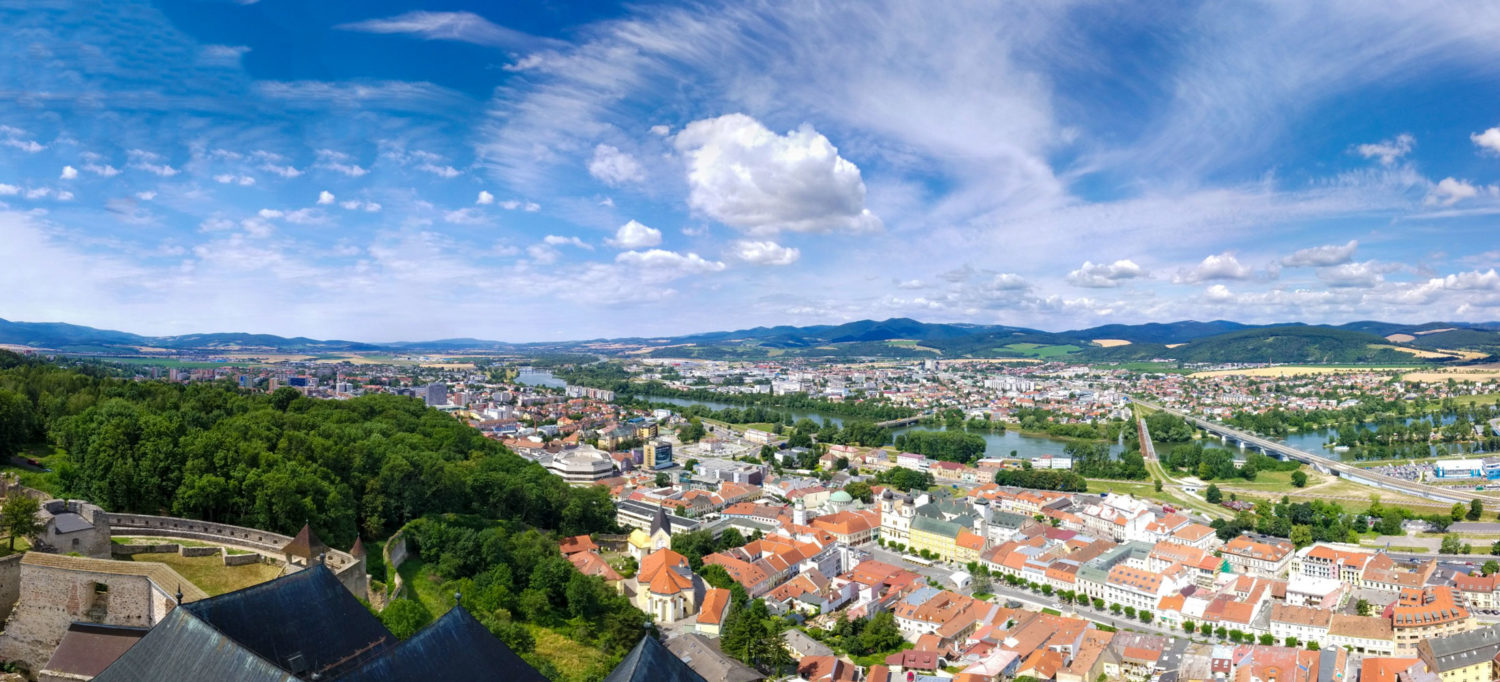
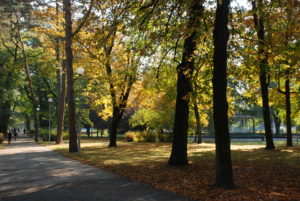
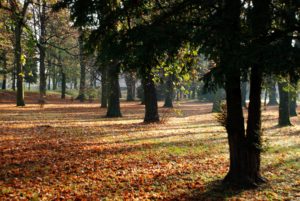
Park M. R. Štefánika in Trenčín is one of the oldest city parks, with a history dating back more than 150 years. It connects the city centre with the railway and bus stations and offers a pleasant environment for walks and relaxation. During its existence, the park has undergone many changes, from floods and military events to modernisations and expansions. It is a place not only for relaxation but also for culture and monuments that recall the rich history of Trenčín.
History and Development of M. R. Štefánika Park
Although it may not seem so, M. R. Štefánika Park in Trenčín is already more than 150 years old. It connects the city centre with the railway and bus stations and provides a pleasant environment for walks and sitting. The originator of the idea to establish a park in places that were occasionally flooded and threatened by the Váh River was the Trenčín parish priest – abbot Ľudovít B. Stárek. The first founders of the park were J. Nozdrovický and I. B. Burian in the years 1860 – 1865. From the beginning, the park was used for various celebrations and gatherings. Between 1856 – 1873 the park was affected by natural disasters, especially floods. The devastation of the park was also caused by the retreating and defeated troops of General L. Benedek’s army from the Austro-Prussian War in 1866. The ceremonial reopening of the park took place on 13 May 1880.
In 1886, various species of trees and plants were planted in the park and marked with signs bearing their Latin and Hungarian names, which attracted interest in the park. The city park also had a tradition of regular concerts from 1888 until the outbreak of World War I in 1914. Military bands performed here in the main large flower circle of the park, where several older trees stood. Particularly remarkable was a 105-year-old ash tree (34 m high). It was called the “music sheet tree” because on its lower trunk, which had a circumference of 455 cm, the concert programme was usually hung on a glass board.
Flooding of the Park
In the summer of 1894, the city park was struck by a major disaster. The Váh River broke through the embankments on the northeastern side of Horná Sihoť and found one of the main channels of the Kubranský Stream, next to which the park itself was located. The water flooded the park in places to a height of more than 3m and completely destroyed the low plants. When the water receded, the park had to be completely reconstructed. Due to the extensive damage caused by the floods, the channel of the Kubranský Stream was moved to another location. After the complete filling of the Kubranský Stream, a system of winding paths was built here, which was later modified and thus a straight asphalt road connecting the city with the railway line was created.
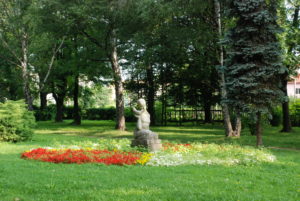
During World War II, shelters were dug here. Behind the large flower circle in the middle of the park with the statue of Venus stood a filagoria – a pavilion – and nearby grew a horse chestnut tree called the “strike ultimatum tree”. The name is related to the student strike in 1903. It was 138 – 150 years old, 23 m high and at a height of 120 cm above the ground had a circumference of 323 cm3.
Traditions, Gardens and Memorials
On 20 May 1906, the botanical garden was opened to the public. It had the shape of an irregular rhombus and covered about 150 m2. Through the centre of the botanical garden ran an artificially created mountain formation, which formed northern and southern slopes for plants with different requirements. The entire area was divided into 23 small plots. About 300 species of plants were planted on this artificially structured terrain, marked with name boards. At first, the botanical garden enjoyed unusual interest from the town and tourists. However, due to insufficient supervision it was gradually destroyed, disappeared after 1910 and today no trace of it remains.
Since 1 May 1907, the city park has been electrically lit. In 1912, a water supply system was introduced, used for watering grassy areas and flower beds. Between 1918 – 1938 the city council proposed to establish an ornithological garden instead of the former botanical garden. Various bird cages were hung in the trees and their singing was meant to replace concerts by the local garrison band. There were peacocks, pheasants, thrushes, parrots, owls, cuckoos and other species. However, some citizens caught the birds, which caused the disappearance of this small zoo.
Music Pavilion
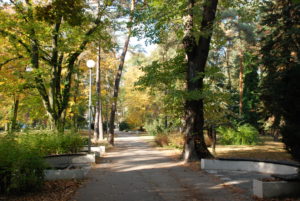
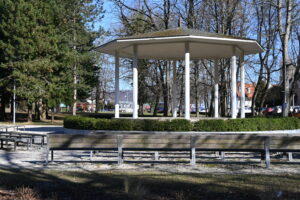
After the war, the reconstruction of the park also began. A round music pavilion with electric lighting was built to preserve the tradition of the musical park. Further development was also connected with the completion of a 38 m long railway crossing near the park. At that time, the railway administration released a considerable part of its former land to the city for the expansion. In this way, between 1952 – 1956 the historical part of the park was expanded by a large sunny area. It was called the New Park. There is a path known as the “second asphalt magistral” with numerous benches, which ends on the road to the new railway line.
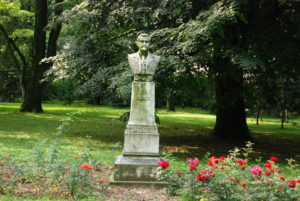
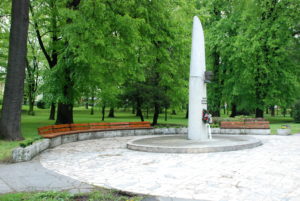
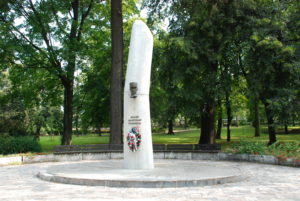
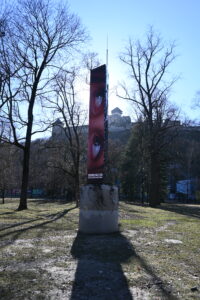
At the edge of the park near the K. Pádivý Elementary School of Arts there is a fountain. On this site previously stood the original memorial to M. R. Štefánik from 1938 by J. Pospíšil, which was later removed for ideological reasons. From the original memorial only the bust has been preserved, which is now part of a new memorial in the shape of a broken wing designed by academic painter Juraj Oravec (from 1998). Several other sculptures and memorials can be found in the park.
Opening hours: freely accessible throughout the day
Admission: free of charge
Gallery